
Kolaj Institute's Artist Development Program is a collection of four core workshops for self-motivated artists, at any stage in their career, who want to develop and expand their collage-based artist practice and work towards professional goals, particularly in the areas of exhibitions and publishing.
At Kolaj Institute, our philosophy is that if we bring artists together, explore ideas and concepts, share knowledge, we can stretch and develop as artists. When we bring that knowledge and skill into our communities, we raise the standing of collage and contribute to the civic discourse. To that end, we offer three core artist development workshops that are designed to support artists gain a deeper understanding of their art practice and to develop their practice so that they can achieve their professional and artistic goals.
Note: You do not have to commit to all four workshops. Use this form if you are interested in Collage in Practice, Curating Collage, Art Writing, and/or Collage Publishing.
Read the full program details here: https://kolajinstitute.org/artist-development/
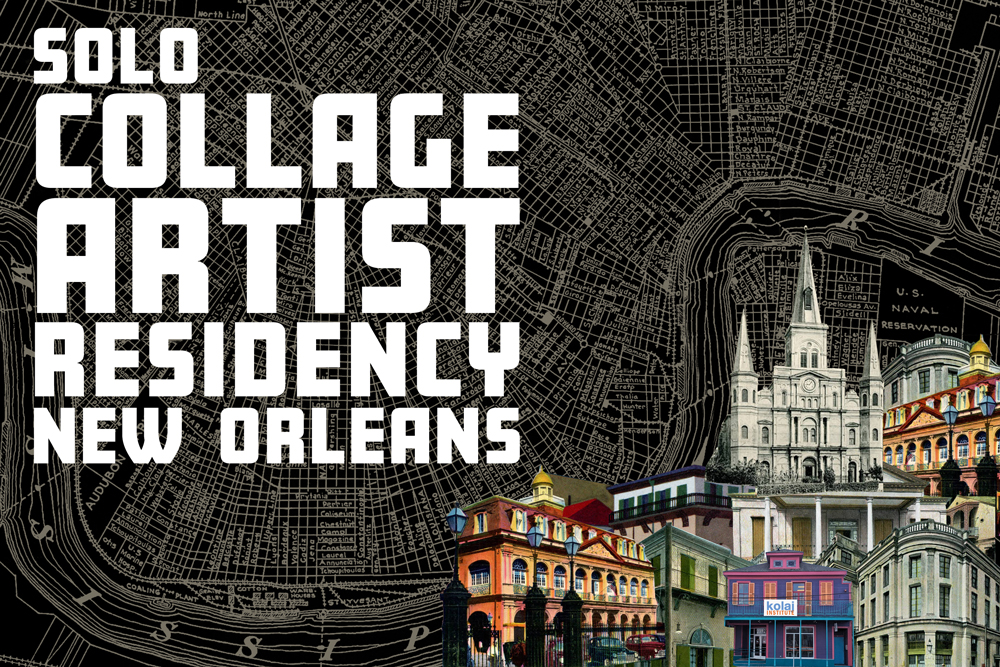
Kolaj Institute Solo Residencies
Dates: One or Two-Week Residencies with dates mutually agreed with Kolaj Institute
DEADLINE: Submissions are being reviewed on an ongoing basis
The mission of Kolaj Institute is to support artists, curators, and writers who seek to study, document, and disseminate ideas that deepen our understanding of collage as a medium, a genre, a community, and a 21st century movement. We operate a number of initiatives meant to bring together community, investigate critical issues, and raise collage’s standing in the art world.
Kolaj Institute’s solo residencies in New Orleans are designed to provide artists, curators, and writers with dedicated time and space to work on a project.
Projects may include things like:
- Completing a series of collage artworks
- Using the archive and collections to researching collage
- Exploring and making art about New Orleans as a place
- Working on a book project
- Creating a collection of collage poetry
- Making a stop motion collage film
- Preparing art for an exhibition
- Developing one’s practice to work on a larger scale
- Or taking a moment to review, organize, and document one’s art practice.
We are open to your ideas. We are looking for artists with an articulated goal for their time in New Orleans. That goal need not to be explicitly related to New Orleans, though priority will be given to those artists whose projects need time in New Orleans.
ABOUT THE RESIDENCY
Residencies may be 1 or 2 weeks. Kolaj Institute provides housing and studio space. Once accepted, Kolaj Institute meets with the resident for a pre-residency assessment where we identify community partners and other resources that can support the project. We then work with the resident to design a plan for their time in New Orleans.
Residents stay in Kolaj Institute’s space at the corner of Saint Claude and Saint Roch Avenues, where they will have their own bedroom, and a shared kitchen and bathroom with shower. (Alternative off-site housing is also available.) Residents work in Kolaj Institute’s Gallery that includes access to collage making supplies and a printer. The Gallery and Resident space is located on the second floor of a building in the Marigny neighborhood. The wrap-around balcony overlooks St. Roch Market. Residents work independently to complete their plan. At the end of the residency, we meet with the artist to review their progress with them and discuss next steps.
COST
The cost of the residency is $900 US for one week (including 6 nights accommodation) or $1400 US for two weeks (including 13 nights accommodation). If the artist is traveling with a partner or companion, there is an additional fee of $400 US per week. A limited number of grants are available in order to offset the fee and reduce barriers to participation to those with a demonstrated financial need. We cannot offer financial aid to cover travel, lodging or food costs.
All travel to and from New Orleans, as well as food and lodging outside of the Residency, are the sole responsibility of the artist.
READ THE FULL CALL TO ARTISTS
PoetryXCollage Open Submission
PoetryXCollage is a printed journal of artwork and writing that operates at the intersection of poetry and collage. We are interested in found poetry, blackout poetry, collage poems, haikus, centos, response collages, response poems, word scrambles, concrete poetry, scatter collage poems, and other poems and artwork that inhabit this world.
Each issue presents six movements of work by artists and curators. Page spreads are meant to be free zones of thinking where the contributor has chosen all elements of the layout: font, image place, composition, etc.
Artists and writers interested in submitting should prepare 3-5 page spreads for consideration. Page spreads must conform to exact specifications and include a general artist narrative and a short page spread narrative. We strongly suggest reviewing a copy of PoetryXCollage prior to submitting. We also recommend downloading the PoetryXCollage Specs Doc pdf and reviewing its contents. You can download this Transparent PNG Template to make sure your submission is the correct size and accounts for the bleed and gutter.
Learn more about the PoetryXCollage project on Kolaj Institute's website HERE.
Questions? Send an email.
Kolaj Magazine‘s Artist Directory is a tool for organizing and cataloguing artists who work in the medium of collage. Its audience includes the general public as well as independent curators, art venues, and writers.
What Is the Kolaj Magazine Artist Directory?
Kolaj Magazine Artist Directory is a membership-based directory and advertising program. The editorial staff of Kolaj Magazine uses the Artist Directory to select artists to feature in the publication and to select artists for various curatorial projects and the Artist Directory exists as a public resource for those interested in collage as a medium and is designed to put interested parties in direct contact with artists. Members of the Artist Directory are permitted and encouraged to refer to their Listing when responding to Calls to Artists as a way of facilitating their response. The Kolaj Magazine Artist Directory is the primary online gateway of the Kolaj Institute Artist Archive and is used to organize online information about artist members. We offer members an option for an Artist Advertisement in the printed magazine.
Sign-Up Options
OPTION 1: ONLINE ONLY
The cost of a 12-month membership to the online Kolaj Magazine Artist Directory is $30.00.
OPTION 2: ONLINE & PRINT EDITION
The print edition of Kolaj Magazine features a directory of collage artists. (see example here) Listings are paid advertisements that feature an image as well as the name; city, state, & country; and website or email of the artist. The listings appear in a box that is 3.7 inches wide and 3 inches tall. After you select and send the images to be featured, Kolaj staff will prepare the listing and send you a digital proof if requested. The cost is $60 per issue (or four issues for $160) and includes a 12-month membership to the online directory.
Sign-Up Process
The registration process will ask you for:
Artist Bio
Artist Statement
3-5 images & captions
Collage Books is Kolaj Magazine’s tool for organizing, documenting, and cataloguing books in which collage plays an important role. Our audience includes readers and collectors of collage books as well as curators, art venues, and writers.
We seek submissions of collage-related titles. We take a broad view of collage books and include trade editions, art criticism, coffee table books, ‘zines, artist books, catalogues, literary endeavours that feature collage.
We accept submissions from traditional publishers, small presses, and individual artists and writers.
Inclusion in the directory is at the discretion of the publisher. If you are interested in advertising in the “Collage Books” section of the print magazine, send us an email for details.
Take a look at some of the Directory pages before submitting so you can see how they are laid out and what information is needed for submission.
Sign-Up Process
The registration process will ask you for:
Title and author information
Publisher information
Book Details
An announcement or press release
3-5 images & captions
Review Copy
If you wish to submit a review copy, you can mail the book to:
CANADA
Kolaj Magazine
c/o Maison Kasini Canada
PO Box 247 Station C
Montreal, Quebec H2L 4K1
[NOTE: If you ship to our Canadian address, please only use your country's postal service. We are unable to receive deliveries shipped via UPS, FedEx, DHL or Purolator.]
UNITED STATES
NOHC
ATTN: Kolaj Institute
2374 Saint Claude Avenue, Suite 260
New Orleans, LA 70117
Collage communities are collectives, meet-ups, ongoing collaborative projects, and groups whose focus and mission involves collage as a medium or genre in some way.
The International Directory of Collage Communities is a survey of artist groups who are coming together around collage. The directory exists online as a searchable website. Kolaj Institute publishes a printed directory that features and highlights communities every two years.
By documenting and mapping these communities, Kolaj Institute works to develop a picture of the collage movement: how collage artists are working together, how they are diffusing collage, and what challenges they face mobilizing an art community.
Kolaj Institute invites active collage communities to submit to the directory. The editorial staff of Kolaj Magazine uses the Directory to select communities to feature in the publication and for various curatorial projects.
The primary purpose of database is be a resource to people seeking information about Vermont contemporary art. Its audience includes the general public as well as independent curators, art venues, and writers.
Art presenters use the Artist Database to select artwork for their venues. Artists may also use the database to market, promote, and sell their work.
Kasini House uses the database to select artists for various projects such as artist portfolios in the Vermont Art Guide. Kasini House also uses the database to select artists for Kasini House Art Cards.
Kasini House promotes the Artist Database as a resource to independent curators and writers looking for artists for various projects, particularly those people interested in writing about and curating exhibitions of Vermont contemporary art.
The cost of a 12-month membership to the online Vermont Art Guide Artist Database is $20.00.
SIGN-UP PROCESS
The registration process will ask you for:
Artist Bio
Artist Statement
3-5 images & captions
Kasini House routinely promotes exhibitions in Kolaj Magazine and on its website. The purpose of this tool is to facilitate the submission of exhibition announcements.
Please note, this is optional. You are welcome to submit exhibition announcements and press releases via email.
Email Kolaj Magazine
In order to promote your exhibition, we will need at least one image of artwork in the exhibition and a caption of the artwork. Do not send posters, images of the exhibition postcard, or images with watermarks.
Materials will be reviewed by magazine staff. Please note, submission does not guarantee that we will promote or review an exhibition. You will be contacted for further information, if necessary.
Collage in Motion is a project of Kolaj Institute that explores collage and the moving image, a broad, loosely defined category that includes animations, film cut-ups, collage film, stop-motion, animated GIFs, documentaries about collage artists, and other forms of media in which collage--as medium or genre--is present. We see our role as not one of defining "collage in motion" but as one of asking what "collage in motion" can be. The project manifests as articles in Kolaj Magazine, an online directory, workshops, residencies, and screenings. Artists with practice of Collage in Motion are encouraged to submit to the online directory.
Kolaj Institute's Collage in Motion Directory is a tool for organizing and cataloguing artists who work in the medium of motion collage. Kolaj Institute uses the Directory to curate the Collage in Motion screening that takes place at Kolaj Fest New Orleans. The Directory's audience includes the general public as well as independent curators, art venues, and writers.
The mission of the Directory is to create more visibility, community, and historical understanding of the medium, and to create a future traveling program of screenings and opportunities. We hope to inspire more still image collage artists to explore motion in their work and that we find each other in an increasingly digital world.
Before submitting, take a moment to view a few examples from the Directory so that you can see how your information will be translated to the page.